

At Includability’s recent Hot Inclusion Topics session, Sara Matthews, Saski and a group of Committed Employers asked whether inclusion or diversity comes first. The answer was to build both together.
Making a Difference: A Simple Guide to the New B Corp JEDI Standards
B Lab Standards V2 made Justice, Equity, Diversity and Inclusion (JEDI) a requirement for every B Corp, backed by evidence rather than storytelling. This guide explains what B Corp JEDI asks for at each company size, how the data and action criteria work, and what to do if you are struggling with V2 JEDI. It also covers how the JEDI Inclusion Toolkit helps you do the work and produce your evidence.
How to Prepare Your Business for the New B Lab JEDI Compliance Standards
Published on
October 14, 2026
Contributors

James Pravato

Includability
Inclusive Community

Table of Content
Doing business for good is changing. If your company is a B Corp, or wants to become one, there is a set of requirements you need to know about. B Lab calls it the JEDI Impact Topic. JEDI stands for Justice, Equity, Diversity and Inclusion, and it is about making sure your business is fair for everyone who works in it and everyone it affects.
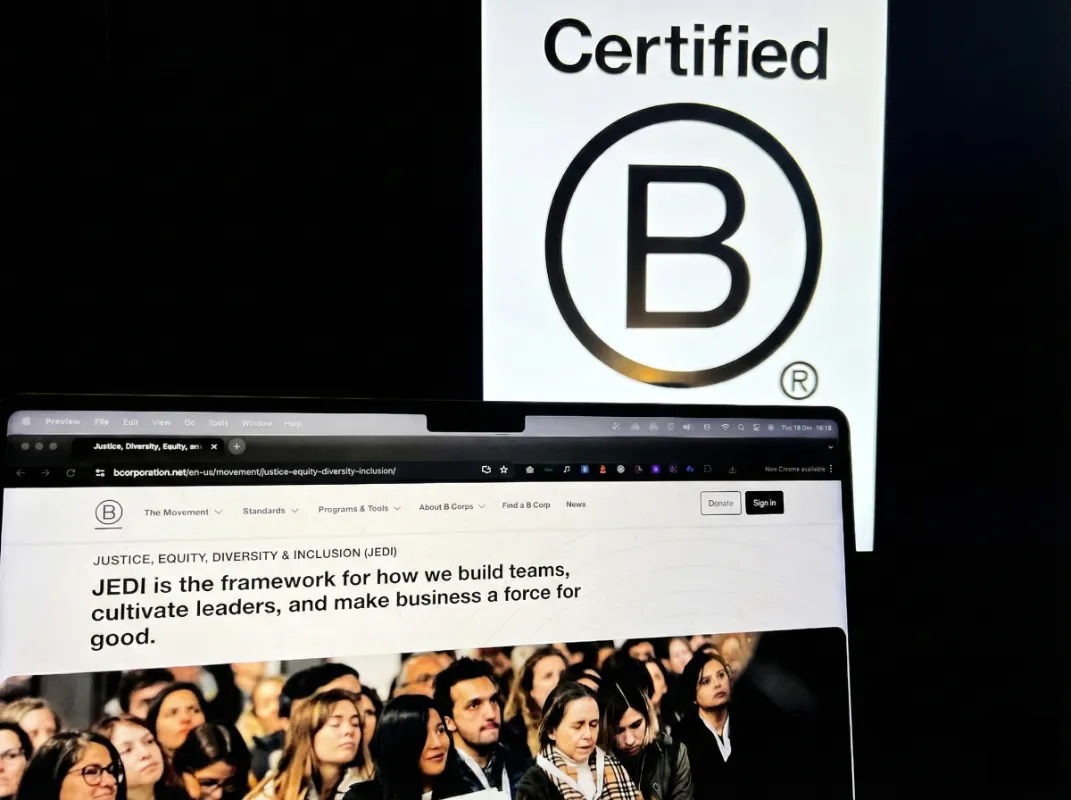
B Lab published its new standards, known as B Lab Standards V2, in April 2025. Since 11 March 2026 they have been used for every B Corp certification and recertification. Under V2, B Corp JEDI is a requirement rather than an option, and you need evidence of what your organisation has actually done.
This guide explains what JEDI for B Corp asks of you, how it changes with the size of your business, and where to start.
What is JEDI?
JEDI is four ideas that work together:
↳ Justice: removing the deep, long-standing barriers that stop some people getting the same opportunities as others
↳ Equity: giving people the support they need, because not everyone starts from the same place
↳ Diversity: welcoming difference, including race, age, sex, gender identity, disability, sexual orientation, religion and social background
↳ Inclusion: making sure everyone feels they belong, can speak up and has a say in decisions
JEDI is one of seven Impact Topics in B Lab Standards V2. The others are Purpose and Stakeholder Governance, Fair Work, Human Rights, Climate Action, Environmental Stewardship and Circularity, and Government Affairs and Collective Action.
Why It Matters
Under the old B Impact Assessment, a company could score well elsewhere and skip inclusion. V2 ended that. Every B Corp now has to meet minimum requirements in each Impact Topic, and JEDI is one of them.
The bigger reason is the people in your business. When people can see that hiring is fair, pay is fair and their voice changes things, they are more likely to stay, speak up and do their best work. A JEDI approach built on real data shows you where that is already happening and where it is not.
Verification under V2 is carried out by independent, B Lab-approved assurance providers. They look for evidence: data you have collected, decisions you made because of it, and actions you can show were carried out.
What You Need to Do
The B Corp JEDI Impact Topic has two requirements. JEDI1 is about data. JEDI2 is about action. Which criteria apply depends on your size and on your certification year: Year 0, when you first certify or move onto V2, then Year 3 and Year 5.
1. Collect the Facts (JEDI1)
You cannot fix what you do not measure. JEDI1 asks you to collect data to inform your JEDI actions.
- JEDI1.1 applies from Small companies upwards, at Years 0, 3 and 5. Below 50 workers, that means a worker survey or a facilitated discussion about JEDI, run anonymously and voluntarily. At 50 workers and above, it means data on gender identity or sex at birth across at least five worker-related measurements, such as hiring, pay and promotion
- JEDI1.2 applies to Large companies and above, at Years 3 and 5. It adds a second social identity, such as race and ethnicity or disability, chosen using feedback from your workers and stakeholders
The point is to find out whether some groups of people are having a harder time at work than others, so your actions go where they are needed.
2. Take Real Action (JEDI2)
Once you have your data, you choose and carry out JEDI actions. There are nineteen to choose from, in three sets:
- Foundation (JEDI2.a to 2.e): a public commitment, leadership knowledge and capacity, a policy review, governing body diversity and an equity audit
- Within the workplace (JEDI2.f to 2.l): inclusive hiring, mentoring and sponsorship, employee resource groups, inclusive language and accessible internal communication
- Beyond the workplace (JEDI2.m to 2.s): an accessible website, inclusive external communication, and reporting your JEDI plan and progress publicly
How many actions you need depends on your size and certification year, set out in JEDI2.1 to JEDI2.6. From Micro upwards, at least one action must come from each of the three sets across Years 0, 3 and 5. You also need to use your JEDI1 data to choose your actions.
A plan that stands up to verification is written down and in use. It names:
- Deadlines: when each piece of work will be done
- Resources: the budget, time or tools behind it
- Responsibility: who is in charge of making it happen, and who signed it off
What to Look For Based on Your Size
B Lab sorts companies into size bands. Your band follows whichever is lower, your full-time equivalent workers or your revenue. The JEDI1.1 data threshold is worked out separately and follows headcount.
- Micro: 1 to 9 workers
- Small: 10 to 49
- Medium: 50 to 249
- Large: 250 to 999
- X Large: 1,000 to 4,999
- XX Large: 5,000 and above
For Micro Businesses (1 to 9 Employees)
- No JEDI1 data requirement: JEDI1.1 starts at Small
- A small number of actions: rising to three by Year 5, with at least one from each set across Years 0, 3 and 5. A public commitment to JEDI and an accessible website are common starting points
For Small Businesses (10 to 49 Employees)
- Talk to your team: run a worker survey or a facilitated discussion about fairness at work, anonymously and voluntarily, at Years 0, 3 and 5
- Pick your actions: rising to four by Year 5, chosen using what your team told you
For Large or Enterprise Businesses (50+ Employees)
- Deeper data: from 50 workers, collect data on gender identity or sex at birth across at least five worker-related measurements, such as hiring, pay and promotion
- More than one identity: from Large (250 workers) upwards, add a second social identity at Years 3 and 5, chosen with feedback from your workers
- More actions: rising to five for Medium, six for Large, and seven for X Large and XX Large
Struggling with V2 JEDI for your B Corp? What to do next
Lots of B Corps find JEDI the hardest Impact Topic to evidence. The good work is often already happening. It is just spread across people, inboxes and folders, with nothing pulling it together. If that sounds familiar, try this order:
- Check your size band and certification year. That tells you which JEDI1 criteria apply and how many JEDI2 actions you need
- Find out what you already have. List the policies, training, surveys and commitments already in place, and note which criteria each one supports
- Fill the data gap first. If you have no workforce data, start with a survey or discussion, because your actions need to come from it
- Choose actions you can sustain. Pick from all three sets, in the number your band needs, and write them into a plan with owners, deadlines and resources
- Keep the evidence as you go. Dated approvals, survey reports, plan updates and training records are what verification looks for
If you are not sure where your gaps are, a gap analysis saves you guessing.
How can Includability help?
Includability is a UK B Corp workplace culture business. B Lab certifies B Corps. We help you do the work and produce the evidence.
- The JEDI Inclusion Toolkit. Thirteen self-paced modules on the Includability Academy, with guidance, templates, videos and slide decks. Every module names the JEDI criteria it supports and the evidence it produces. Four are free, and it is self-paced, so it can fit into your busy day
- The Self-ID Survey. With Option two, we build and run your survey, then give you structured analysis with a headline summary report. For organisations of up to 250 people
- The Cultural Roadmap. It includes a JEDI Gap Analysis that shows where you stand today, so you can go straight to the modules that close your gaps
What is in the JEDI Inclusion Toolkit?
- Introduction to JEDI and B Corp V2 (free): what JEDI asks of an employer and how B Lab Standards V2 measures it
- Self-ID Surveys (free): how to collect workforce data people trust. JEDI1.1, JEDI1.2
- Supporting Learning Management (free): a training needs analysis and a tracker. JEDI2.b
- Developing a Data Approach: what to collect, how to protect people and how to read the results. JEDI1.1, JEDI1.2, and it feeds the Fair Work data criteria
- Creating and Implementing a JEDI Action Plan: priorities, owners and progress tracking. JEDI2.1 to JEDI2.6, JEDI2.n
- Gathering Worker and Stakeholder Feedback: feedback routes and employee resource groups. JEDI1.1, JEDI2.f
- JEDI Leadership Team Tools: a maturity matrix, example commitments and accountability at leadership level. JEDI2.a, JEDI2.b
- Inclusive Communications and Accessible Events: a communications policy, events checklist and digital accessibility checklist. JEDI2.i, JEDI2.l, JEDI2.p
- Reviewing and Updating Policies With a JEDI Lens: a policy review process and a record of what changed. JEDI2.c
- Inclusion Assessments: a framework to assess policies, projects and events and record the impact
- Inclusive Hiring, Onboarding and Induction: attraction, selection and onboarding. JEDI2.g
- Talent Pooling and Developing Talent: mentoring, sponsorship and keeping your people. JEDI2.h
- The JEDI knowledge base (free): source material behind the toolkit
There is no write-up at the end. The plans, policies and data you produce along the way are your evidence.
Pricing: the full toolkit is £999 plus VAT, or £650 plus VAT for Committed Employers. The Option two Self-ID Survey is £2,500 plus VAT per survey. Introductory 2026 pricing, subject to change.
The Roadmap shows the gaps. The toolkit closes them and produces your evidence.
Ready to lead the change?
Not Sure where to start? Book a Call >
Question we are often asked
If I’m struggling with V2 JEDI for B Corp, what should I do?
Start by checking your size band and certification year, because they decide which criteria apply. Then list what you already have, collect your workforce data if you have none, and choose actions from all three sets in the number your band needs. A JEDI Gap Analysis or the free Introduction to JEDI and B Corp V2 module will show you where to begin.
What does B Corp JEDI mean?
JEDI stands for Justice, Equity, Diversity and Inclusion. It is one of seven Impact Topics in B Lab Standards V2, and it asks companies to collect data on their workforce and take action on what it shows.
Is JEDI for B Corp the same as EDI or DEI?
They cover similar ground. JEDI adds justice, which is about removing the structural barriers behind unequal outcomes, and B Lab sets specific criteria for it. Good EDI or DEI work you already do can often count as evidence.
Do all B Corps have to meet the JEDI requirements?
Yes. Every B Corp certifying or recertifying on V2 has to meet the JEDI Impact Topic. What it asks for is scaled to size, so a Micro company has less to do than a Large one.
Do we have to do all nineteen JEDI actions?
No. You choose from three sets, Foundation, Within the workplace and Beyond the workplace. Your size and certification year set how many you need, with at least one from each set across Years 0, 3 and 5.
What counts as evidence for B Corp JEDI?
The things you produce while doing the work. A dated commitment with the approval minute, a survey report, an action plan with named owners and progress updates, completed policy reviews and training records.
Does Includability certify B Corps?
No. B Lab certifies, and independent assurance providers carry out verification. Includability helps you do the JEDI work and produce the evidence.
Do we need to be a B Corp to use the JEDI Inclusion Toolkit?
No. Every module is good inclusion practice for any employer. It is built for B Corps, so each module also names the B Corp JEDI criteria it supports.
Related resources & events

JEDI
Inclusive recruitment: fairer adverts, selection and onboarding, from first click to first month
Every stage of hiring can widen your talent pool or quietly narrow it. The Inclusive Hiring, Onboarding and Induction module gives you inclusive job adverts, fairer selection methods, an onboarding checklist and guidance on AI in recruitment, from the first advert to the first month in the job.
Sign up for our newsletters
We have an employer and Job seeker newsletter giving you all the latest information in one easy and digestible email. Sign up today for news and job advice straight to your inbox.