

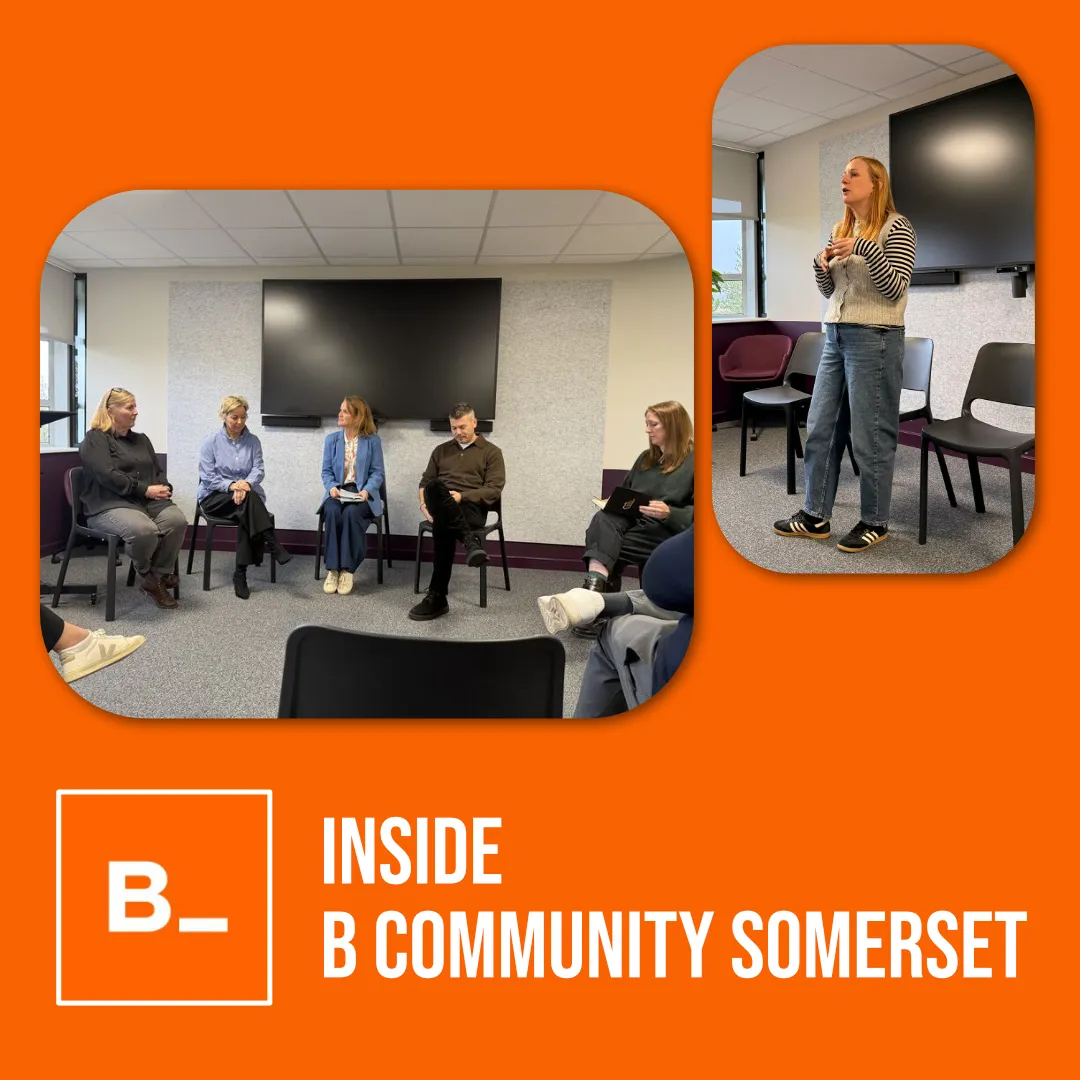
B Community Somerset brought B Corps together in Taunton to talk through the new B Lab standards. What we heard, and why the people side of B Corp needs the whole business behind it.
Inside B Community Somerset: Why the New B Corp Standards Need the Whole Business
B Community Somerset brought B Corps together in Taunton to talk through the new B Lab standards. What we heard, and why the people side of B Corp needs the whole business behind it.
B Community Somerset and the New B Corp Standards
Published on
November 12, 2026
Contributors

James Pravato

Includability
Inclusive Community
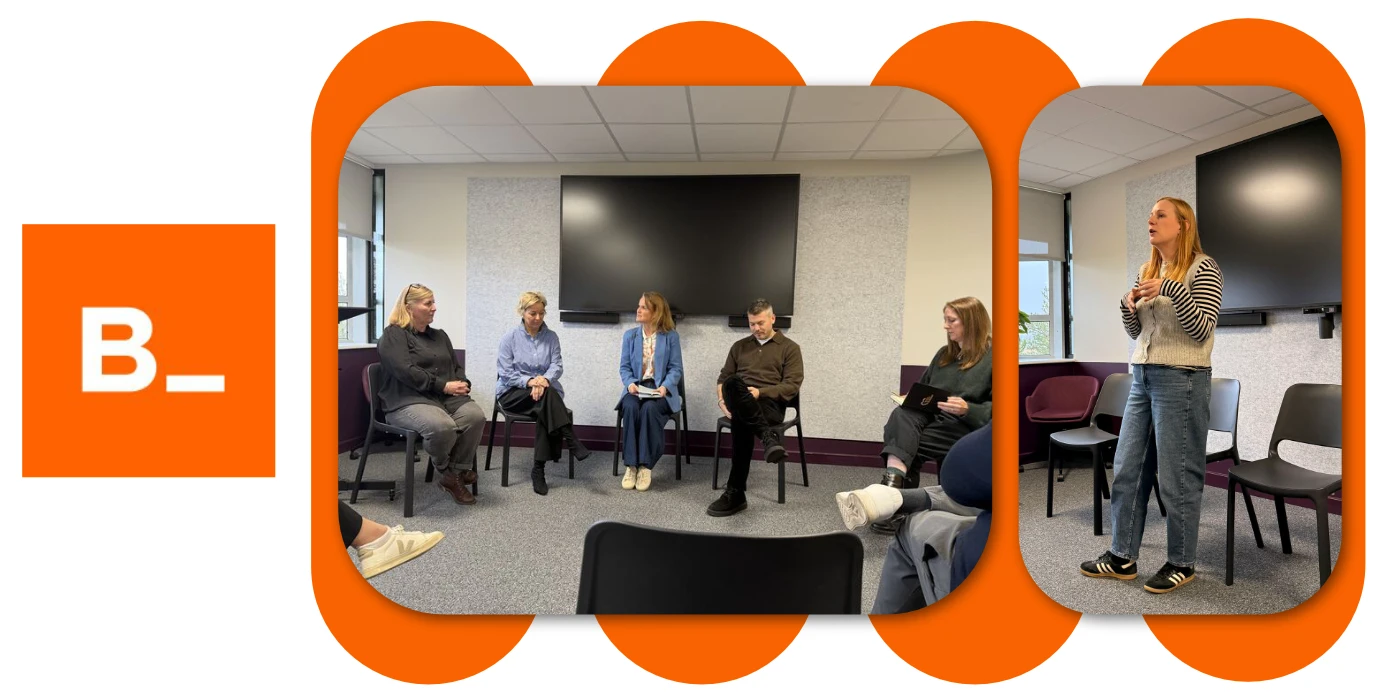
Table of Content
B Community Somerset is building something the South West really needs.
At B Community Somerset this week, most of the people leading B Corp work were sustainability specialists. Under B Lab's new standards, some of the hardest evidence to build is about pay, inclusion and culture, and it needs the whole business behind it.
On Wednesday 11 November, B Community Somerset and Stephens Scown hosted a breakfast in Taunton for B Corps and businesses thinking about becoming one. Rosie Wollacott, Head of Sustainability at Mulberry, talked through version 2 of the B Lab standards. Catherine Coward from The Good Crowd then chaired a panel with Claire Gibbs, who works in food and sustainability at Charlie Bigham's, representing larger businesses, Sue Happs from Teals for medium-sized businesses, Lizzie Tottle from Teapot for small businesses and Ashley Webber from Balanced for start-ups.
Ask whether being a B Corp changes who you buy from, and the honest answer is that it depends on your size and where you're looking from. It was a friendly, practical morning, with a real appetite to keep the conversation going.
Most of the people leading B Corp in their organisations had sustainability in their job title, from sustainability managers to sustainability and impact directors. That makes sense, because a lot of the morning was about environmental performance. At the same time, the new standards ask for a lot of evidence that a sustainability role can't produce on its own.
Why B Corp often sits with one person in sustainability
B Corp grew up with a strong environmental focus, so in larger businesses it tends to land with whoever runs sustainability. In smaller ones there usually isn't a sustainability manager at all, and B Corp falls to a founder, an operations lead or whoever put their hand up.
Either way, it often ends up resting on one person or one team. B Lab's own standards team sees a version of the same split. Bernard Gouw, Senior Social Standards Manager at B Lab Global, explains that JEDI and Human Rights are kept as separate impact topics partly because companies usually hand them to different teams.
The new standards cover seven impact topics, and three of them are mainly about people: Fair Work, Human Rights, and Justice, Equity, Diversity and Inclusion (JEDI). The evidence for those sits with HR, with leaders and line managers, and with the people who work there. Pay data, workforce data, worker feedback and how decisions get made all live there.
A sustainability lead can coordinate the B Corp work, but they can't produce that evidence on their own, and it isn't fair to expect them to.
What changed in the new B Lab standards
B Lab published its new standards in April 2025 after four years of consultation with businesses, civil society, academics and policymakers, according to B Lab UK. The old points system, where a company could choose where to score, has gone. Every B Corp now has to meet minimum requirements across seven impact topics: Purpose and Stakeholder Governance, Climate Action, Fair Work, Human Rights, Government Affairs and Collective Action, Environmental Stewardship and Circularity, and JEDI.
Performance is checked by independent third-party assurance, and certification now runs on a five-year cycle. Companies meet the Year 0 requirements to certify, then further requirements at Year 3 and Year 5, and at each milestone they still have to meet everything that came before, as Linklaters sets out. B Lab says micro and small companies will be audited at Year 0, Year 3 and Year 5, while larger companies are likely to be audited every year.
On 2 September 2026, B Lab UK announced the first UK businesses certified under the new standards, as the UK community passed 3,000 B Corps. Mulberry, founded in Somerset in 1971, is one of them.
Why Year 3 and Year 5 are where the people evidence gets tested
Year 0 is achievable for most businesses that put the work in. In my experience, the harder part comes at Year 3 and Year 5, when a company has to show it has kept going, with structure, data and evidence that build up over time rather than appearing at the last minute.
JEDI shows how that works. The first JEDI requirement asks companies to collect demographic data from their workers, and B Lab has written guidance on doing that within stricter privacy rules. The second is a menu of 19 actions across three sets, covering things like inclusive hiring, supplier diversity and diversity among leaders. Depending on size, a company completes between one and seven of them, and the number of actions is tied to the Year 0, 3 and 5 milestones. Micro businesses and companies without workers are exempt from the first requirement and take on fewer actions, B Lab explains.
Fair Work brings pay and culture together. B Lab says its fair wage practices include checking equal pay for work of equal value and paying the lowest paid a living wage or a collectively bargained wage, where a living wage means enough for a worker and their family.
Fair Work also took in the workplace culture topic from the earlier drafts. When B Lab was drafting it, it defined culture through measures including satisfaction, wellbeing, mental health, belonging and psychological safety.
That kind of evidence takes a few years of asking people how they're doing, acting on what they say, and keeping a record a leadership team can stand behind. It can't be written up in the month before recertification.
It's also where a lot of B Corp's value for employees shows up. B Lab UK's Take 10 report, published in November 2025 and drawn from B Impact Assessment data from 2019 to 2025, found UK B Corps were 26% more likely than ordinary businesses to pay family living wages to all workers, and 31% more likely to keep the gap between their highest and lowest earners under 5:1.
In B Lab UK's community survey, run at the end of 2024 with more than 700 UK B Corps responding, half said certification had helped them attract and retain talent.
Where the Cultural Roadmap fits
Includability became a B Corp because we wanted to be a better business, and we wanted a framework to follow to do that. We still think B Corp is a really good framework. A lot of our work now is helping other organisations take the parts of it that are about people and build them into how they run, through our Cultural Roadmaps.
A Cultural Roadmap looks at an organisation across six pillars: Diversity and Inclusion, Mental Health, Wellbeing, Sustainability and Impact, Talent Management, and Leadership and Governance. It's built from a Company Support Survey, six calls with independent Partner Experts, one for each pillar, and whatever data the organisation already holds. The result is a board-ready report on where it stands and what to do next.
Every roadmap includes a JEDI Gap Analysis. For B Corps, and organisations planning to become one, that's the B Corp JEDI Gap Analysis. It shows what's already strong, where evidence is partial, where there are full gaps, and what needs to be in place before Year 3 and Year 5. It doesn't replace B Lab's process, but it does show where the evidence will come from and who needs to be involved.
Where the gaps call for it, the JEDI Toolkit on the Includability Academy takes an organisation through the work one section at a time, from collecting workforce data to writing an action plan and reporting on it. The same data carries into Fair Work, including the gender wage gap calculation, worker feedback and regular measurement of workplace culture.
The point of all of it goes beyond B Lab. It's about building a culture where people want to be, so you can attract, retain and develop talent, with clear pathways into the business and out of it when that's someone's next step.
Why Includability is built for the people side of B Corp
Sustainability and Impact is one of our six pillars, reviewed by Laura Slack of Planet and Purpose, and it sits in the same roadmap as the people pillars. That keeps the sustainability lead at the centre of B Corp, with HR, leaders and the rest of the business sharing the load around them. B Corp needs to be a collective effort, rather than something that relies on the sustainability and impact person alone.
The other pillars are reviewed by people who work in them every day. Sara Matthews covers Diversity and Inclusion and Talent Management, Matthew Holman of Simpila Wellbeing covers Mental Health, Matthew Lock of Outliers Wellbeing covers Wellbeing, and Will Cleare of The HR Agency covers Leadership and Governance.
We're a micro business in B Corp terms, but what makes the difference is that we understand the framework and believe in it. To be a better business and do the right things, you need a framework you can buy into. Is it perfect? No, but nothing is.
Where we get a different perspective is through our clients. We work with B Corps like Lucky Saint, Cook, Tyler Grange, Danone and Peak PEO, plus many more, so we understand what B Corp requires and how to support organisations through it in the best way.
That gives companies the best chance to be better businesses, to be more inclusive, diverse and mentally healthy, and to make sure the people side is properly looked after. Our community of Committed Employers and Partners is working through the same questions, so nobody has to do it alone.
What B Corp is worth still depends on your size
B Corp is a commitment and it should be, and nobody in Taunton pretended otherwise. What it's worth to you also depends a great deal on your size.
Larger businesses often do it partly because their competitors have, and they need the brand and the competitive edge that comes with it. Smaller businesses want that edge too, and many expect other B Corps to choose them as suppliers. B Corps do like working with each other, but in my experience that doesn't always turn into work for a small business.
Medium-sized businesses are often where B Corp moves the needle most. They have enough scale to put the framework to work, and their customers increasingly want a more sustainable supply chain.
A Cultural Roadmap doesn't certify anyone. B Lab does that. What we can do is make sure the people evidence is there, and owned by the right people, when Year 3 comes round.
Why B Community Somerset matters for the South West
Unless you're in Bristol, which has plenty of B Corps, the South West is woefully represented at B Corp events, and it's very difficult to get people to come down this way and give talks. So fair play to B Community Somerset. They're creating a brilliant community, and it's really good to have one here for those of us in Somerset and Devon, run locally by people who clearly care about it.
Thank you to Lizzie Tottle at Teapot for pulling the morning together, to Stephens Scown for hosting, and to Mulberry, Charlie Bigham's, Teals, Balanced and The Good Crowd for being so open about what's hard.
There's appetite for more of this. In B Lab UK's community survey at the end of 2024, 76% of the 700 plus B Corps that responded said they feel part of a collective movement, and many asked for more local and industry events.
If you're a purpose-led organisation in the South West and perhaps not in Bristol, B Community Somerset is a great group to connect with. Get yourself along to the next session, I'd definitely recommend it.
Related resources & events
Workplace Strategy & People Experience
Is quiet quitting a culture problem, and can data show where it starts?
Only 55% of UK employees would now work harder than required, down from 69% in 2015. The middle is pulling back hardest. Belonging, management and the first rung point to why.
Sign up for our newsletters
We have an employer and Job seeker newsletter giving you all the latest information in one easy and digestible email. Sign up today for news and job advice straight to your inbox.