By clicking “Accept”, you agree to the storing of cookies on your device to enhance site navigation, analyze site usage, and assist in our marketing efforts. View our Privacy Policy for more information.
Why quiet quitting is a culture problem, and how data can show where it starts
Only 55% of UK employees would now work harder than required, down from 69% in 2015. The middle is pulling back hardest. Belonging, management and the first rung point to why.
Fewer UK workers will go the extra mile than at any point in a decade. The evidence points past pay and hours to belonging, management and a thinning first rung of jobs.
In 2015, 69% of UK employees said they would work harder than they needed to in order to help their employer succeed. By 2025, that had dropped to 55%.
Often what happens is nobody resigns and the core job still gets done. What has gone is the extra task that would be picked up without being asked, an idea offered in a meeting, or helping a colleague on a busy day.
Hannah Slaughter, principal economist at the Resolution Foundation, calls it a "dissatisfaction drain". She says it is bad for workers and a poor sign for productivity.
It also takes a toll on wellbeing. In the CIPD Good Work Index 2025, a quarter of UK employees said their work harms their mental health.
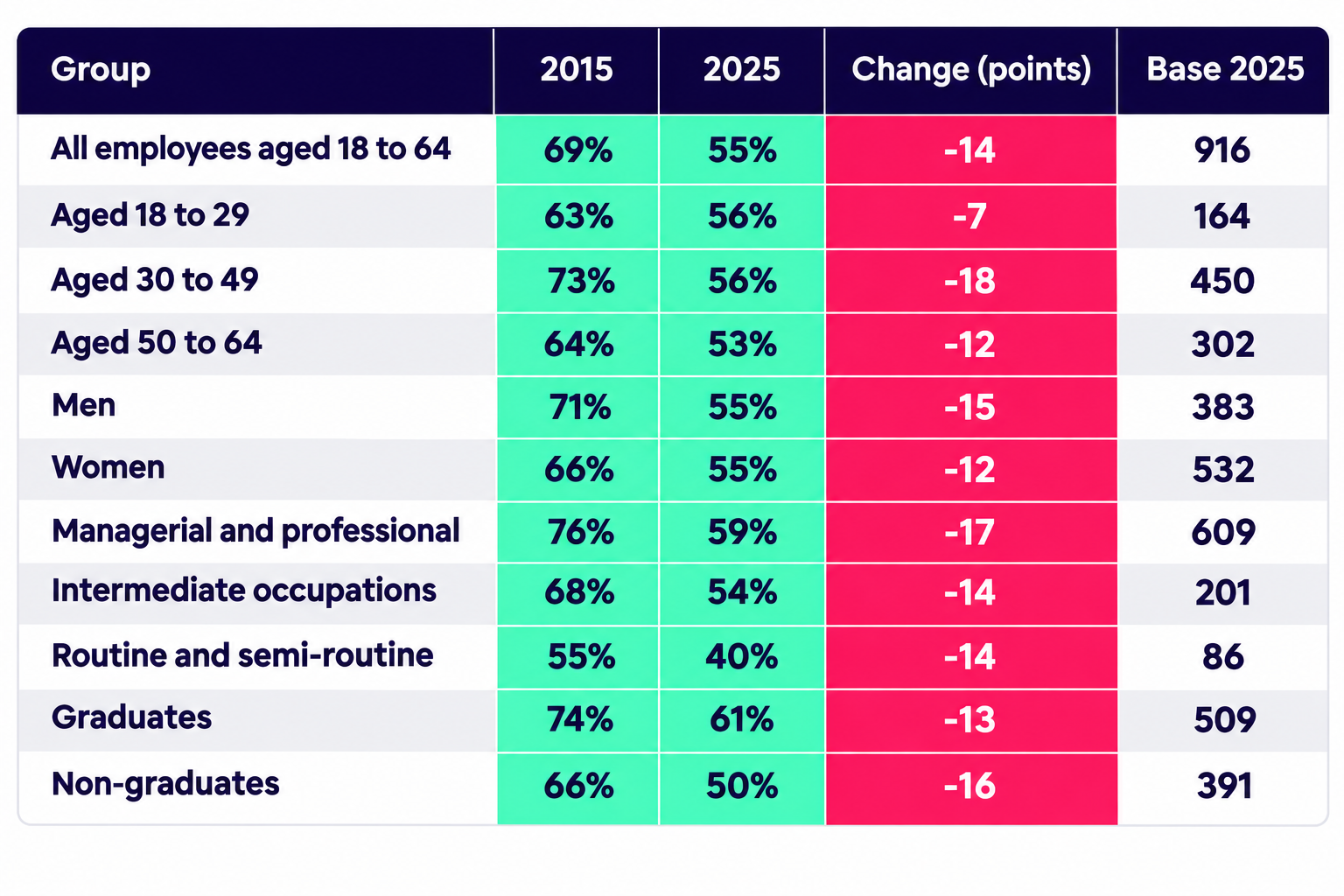
Share willing to work harder than required to help their employer succeed. Source: Resolution Foundation, Work in progress, British Social Attitudes 2015 and 2025, published 2 November 2026. Changes as published by the Resolution Foundation.
Where quiet quitting started
Quiet quitting went viral on TikTok in 2022, and at the time BBC News spoke to UK workers who had done it. For both of them, it started with a promise that was never kept.
Georgia Gadsby March, 24, was working close to 60 hours a week in marketing and had been promised a pay rise that never came. "I felt humiliated," she told the BBC.
Emma O'Brien, 31, had taken on much of her team's workload during Covid and was then turned down for a rise. Both went back to doing what their job description asked and nothing more, and both eventually left.
Career coach Joanne Mallon told the BBC that many of her clients have already quietly quit by the time they come to her, so the first thing she asks is why.
Who is pulling back the most?
The drop isn't limited to one group. It shows up in every age group, among men and women, and at every level of job.
It is steepest in the middle of organisations, with a fall of 18 points among 30 to 49 year olds and 17 points among managers and professionals. Under-30s fell the least, by 7 points.
Routine and semi-routine workers are the least willing of all to go the extra mile, at 40%, although only a small number of people in that group took part in the survey.
Sir John Curtice, co-editor of the British Social Attitudes report, says the data doesn't show young people becoming work-shy. Only 4% of working-age adults say they would rather not work at all, and hybrid workers were the most willing to go the extra mile in 2025, at 62%.
Why belonging matters so much
We spend a large part of our lives at work, so how we feel when we're there has a big effect on how much we give.
The CIPD Good Work Index 2025, a survey of 5,017 UK employees, found that feeling miserable or lonely at work were the factors most closely linked to people planning to quit and to lower performance. In Gallup's State of the Global Workplace 2026 report, 18% of UK employees said they had felt lonely for a lot of the previous day, compared with 13% across Europe.
Belonging is also often the difference between someone speaking up and someone quietly switching off. At Includability's October Community Support Group, Sara Matthews, our Culture and Inclusion Director, drew on her time at Chelsea FC. Her suggestion was to take people out of the pack for a coffee and have an ordinary conversation about how things are going.
Managers promoted for the job, not the people
Many managers are promoted because they're good at the technical side of their role, not because they're good with people.
A Chartered Management Institute study with YouGov, covering more than 4,500 UK managers and workers in 2023, found that 82% of people who move into management have had no formal management or leadership training. The same study found that one in three people had left a job because of a negative work culture.
Claire Gray, founder of NeuroTalent at Work, told our October Community Support Group that many of the line managers she trains were promoted for being good at their role and then given very little support with managing people.
Matthew Lock, co-founder of Outliers Wellbeing and our Wellbeing Partner Expert, made a similar point. Organisations say they want psychological safety and human-centred leaders, he said, but manager KPIs rarely point back to culture.
That has a knock-on effect on performance. The CIPD found that 91% of employees who say their manager respects them meet their job objectives, compared with 75% of those who don't.
Fewer junior roles, fewer places to learn
At the other end, the first rung of the career ladder is getting thinner. UK starter vacancies fell by 49% between 2016-17 and 2025-26, according to Work Foundation analysis of Adzuna data.
In a Survation poll of 1,001 senior business leaders for the Work Foundation, 43% said they had invested in AI or automation that reduced entry-level roles. Among large employers, that rose to 60%.
Ann Francke, chief executive of the Chartered Management Institute, warned in January 2026 that a young person can lose confidence and leave a job because their first manager didn't know how to manage them. With fewer junior roles, there are also fewer places for people to learn the job in the first place.
"Too many managers are promoted for their technical skills rather than for being good with people."
James Pravato, CEO and Co-Founder of Includability, said:
"We spend a huge part of our lives at work. When the culture is inclusive, diverse and mentally healthy, people feel they belong, and they talk openly about how they feel and what they want from their workplace. Quiet quitting is what happens when that conversation stops. Too many managers are promoted for their technical skills rather than for being good with people. At the same time, junior roles are being replaced by AI, so organisations fill gaps with mid-level hires and lose the place where people learn. It starts with intent: leaders who want this culture, and who put evidence and a plan behind it."
Where employers can start
Pay and hours do still matter. 78% of UK workers say a high income is important to them, but only 23% say their job gives them one. And while 61% want a say over their working hours, only 31% have it.
Measure it by group. Ask people whether they'd go the extra mile, whether they feel they belong and whether they can see a way up. Then split the answers by team, role level, age and gender, so you can see where the drop is happening.
Make it safe to talk. Give managers the time for regular one-to-ones where workload and wellbeing are on the agenda, and show people what changes as a result.
Promote for people skills. Make managing people part of the promotion criteria, and train every new manager in their first 90 days.
Protect the first rung. Either use AI to take repetitive tasks out of junior roles or teach those starting out how to use ai to optimise these roles, rather than removing the roles altogether.
Where Includability can help
Quiet quitting rarely comes down to one cause. Belonging and inclusion often sit with one team, managers with learning, junior hiring with talent, pay with reward and mental health with wellbeing. Each can look fine on its own while discretionary effort drains away between them.
An Includability Cultural Roadmap brings those threads together. Six independent Partner Experts each lead a conversation on one pillar: Diversity and Inclusion, Mental Health, Wellbeing, Sustainability and Impact, Talent Management, and Leadership and Governance. We combine that with your own data and a temperature check survey of from your leaders, and turn it into a prioritised plan your board can read, with a JEDI and Burnout Risk Review built in.
Quiet quitting means doing the job you're paid for and nothing beyond it. People stay in their role and meet their objectives, but stop taking on extra tasks, working unpaid hours or answering messages after hours.
Is quiet quitting increasing in the UK?
Yes, on the best measure available. The share of UK workers willing to work harder than required to help their employer fell from 69% in 2015 to 55% in 2025, according to Resolution Foundation analysis of the British Social Attitudes survey.
Is quiet quitting a Gen Z problem?
Not on the latest data. Between 2015 and 2025, willingness to go the extra mile fell by 7 points among 18 to 29 year olds, compared with 18 points among 30 to 49 year olds, according to Resolution Foundation analysis of British Social Attitudes. The LSE study found younger workers cut their unpaid hours the most between 2019 and 2022, but John Curtice says the 2025 data doesn't show young people becoming work-shy.
Is quiet quitting bad for business?
It can be. The Resolution Foundation says falling willingness to go the extra mile may have contributed to weak UK productivity growth. Where it's about people protecting their health from workloads they can't manage, the better fix is the workload.
What causes quiet quitting?
The main drivers in the UK data are a weak sense of belonging, managers promoted without training in managing people, fewer entry-level roles and ways to progress, pay and hours that fall short of what people expect, and work pressure that harms mental health.
How can employers stop quiet quitting?
By measuring discretionary effort, closing the gaps people care about most, and building a culture where effort is noticed and feels safe to give. In practice that means fair pay, real flexibility, trained managers, a say in decisions and support for mental health.
Is quiet quitting the same as disengagement?
They overlap, but they aren't the same thing. Gallup links quiet quitters to its "not engaged" group, while some researchers see quiet quitting as people setting healthy boundaries.
Can a manager tell if someone is quiet quitting?
Usually not from performance data, because the core job still gets done. The signs show up in what has stopped, such as volunteering, sharing ideas and helping colleagues. A regular one-to-one is often the most reliable place to hear about it.
Who is most likely to quiet quit?
Routine and semi-routine workers are the least likely to go the extra mile, at 40% in 2025, according to Resolution Foundation analysis of British Social Attitudes. Managerial and professional staff are still the most willing, at 59%, but they saw the biggest fall, down from 76% in 2015.
Is AI making quiet quitting worse?
There's no direct evidence yet linking AI to quiet quitting. What we do know is that AI is shrinking entry-level hiring. 43% of senior UK business leaders said they had invested in AI or automation that reduced entry-level roles, in a Work Foundation poll published in August 2026. That narrows the routes in and the routes up, at a time when only 26% of UK workers say they have opportunities for advancement.
About Includability
Includability | B Corp is a UK B Corp workplace culture business. We partner with organisations to build inclusive, diverse, mentally healthy, evidence-based workplace cultures through Cultural Roadmaps. We work alongside them as a strategic partner to leadership teams, a colleague to the people leading culture day to day, and a community of more than 100 Committed Employers and Partners who learn from each other.
Related Downloads
Subscribe to newsletter
Thank you! Your submission has been received!
Oops! Something went wrong while submitting the form.
Only 55% of UK employees would now work harder than required, down from 69% in 2015. The middle is pulling back hardest. Belonging, management and the first rung point to why.
Most organisations have a staff network. Fewer can show what it changed. UK evidence, B Corp JEDI requirements and five actions to make employee resource groups work.
At Includability’s recent Hot Inclusion Topics session, Sara Matthews, Saski and a group of Committed Employers asked whether inclusion or diversity comes first. The answer was to build both together.
A customer wants your EcoVadis score, the board wants B Corp and ISO 37011 is on its way. Twelve frameworks compared, and how to build evidence once that works for all of them.
The talent you need next is often already working for you. The Talent Pooling and Pipelines module helps you find it, develop it fairly and make sure progression is open to everyone, not just the people already in the right conversations.
Every stage of hiring can widen your talent pool or quietly narrow it. The Inclusive Hiring, Onboarding and Induction module gives you inclusive job adverts, fairer selection methods, an onboarding checklist and guidance on AI in recruitment, from the first advert to the first month in the job.
We have an employer and Job seeker newsletter giving you all the latest information in one easy and digestible email. Sign up today for news and job advice straight to your inbox.
Thank you! Your submission has been received!
Oops! Something went wrong while submitting the form.